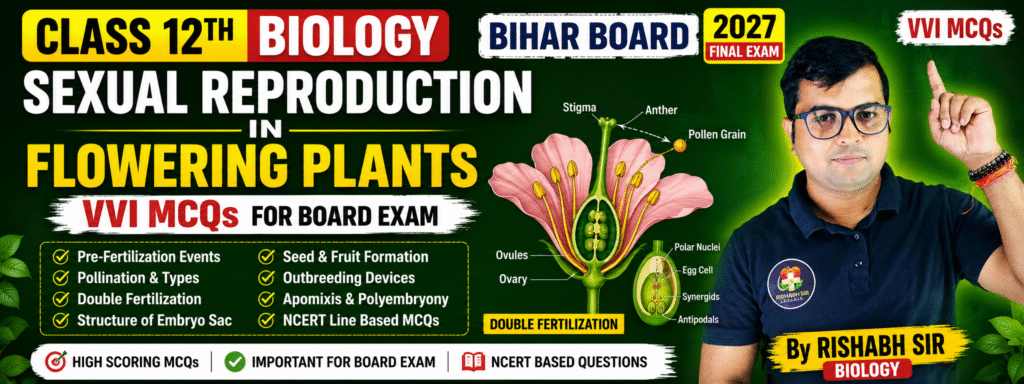
Sexual Reproduction in Flowering Plants is one of the most important and high-scoring chapters for Bihar Board Class 12th Biology Examination 2027. In this video/article, you will get the most expected VVI MCQs, important concepts, NCERT-based questions, exam-oriented notes, and previous year pattern questions that are बेहद useful for final board preparation.
This chapter covers all the key topics like structure of flower, microsporogenesis, megasporogenesis, pollination, double fertilization, embryo sac development, seed formation, fruit formation, and apomixis in an easy and exam-focused way. Every MCQ is specially selected according to the latest Bihar Board syllabus and important for board exams, competitive exams, and revision practice.
If you are preparing for Bihar Board 2027 Final Examination, then these VVI MCQs will help you improve your accuracy, confidence, and score in Biology. Students can revise the complete chapter quickly and strengthen their conceptual understanding with simple explanations and smart tricks.
Topics Covered:
• Pre-Fertilization Events
• Pollination & Types of Pollination
• Double Fertilization
• Structure of Embryo Sac
• Seed & Fruit Formation
• Outbreeding Devices
• Apomixis & Polyembryony
• Bihar Board Important MCQs
• NCERT Line Based Questions
Best for:
• Bihar Board Class 12 Students
• 2027 Board Exam Preparation
• NEET Foundation Biology
• Quick Revision & Practice
By Rishabh Singh – Biology
Don’t forget to practice all MCQs carefully and revise NCERT diagrams for maximum marks in the final examination.
Sexual Reproduction In Flowering Plant Class 12th VVI MCQs Bihar Board
1. How many meiotic divisions are required to form 100 pollen grains?
(a) 100
(b) 50
(c) 25
(d) 20
2. Double fertilization means
(a) Fusion of two eggs
(b) Fusion of egg and pollen nuclei of two pollen grains
(c) Fusion of two polar nuclei and one male gamete
(d) Fusion of synergid and male gamete
3. Pollination by bats is called
(a) Ornithophily
(b) Entomophily
(c) Chiropterophily
(d) Hydrophily
4. Pollination by snails is called
(a) Malacophily
(b) Zoophily
(c) Anemophily
(d) Hydrophily
5. Development of fruit without fertilization is called
(a) Parthenogenesis
(b) Heterostyly
(c) Parthenocarpy
(d) Agamospermy
6. Who discovered fertilization?
(a) Nawaschin
(b) Strasburger
(c) Leeuwenhoek
(d) Robert Hooke
7. Mature seeds in which endosperm persists are called
(a) Endospermic
(b) Non-endospermic
(c) Polyembryony
(d) Apocarpic
8. The processes from zygote to embryo formation are called
(a) Embryogeny
(b) Embryo sac development
(c) Endosperm development
(d) Parthenocarpy
9. Perisperm is the remnant part of
(a) Nucellus
(b) Embryo
(c) Endosperm
(d) Integument
10. In which of the following aril is not found?
(a) Custard apple
(b) Litchi
(c) Mango
(d) Myristica
11. Which of the following fuses with a male gamete to form endosperm?
(a) Unfertilized egg
(b) Synergid cell
(c) Antipodals
(d) Secondary nucleus
12. Entomophily cross-pollination occurs by which of the following?
(a) Bats
(b) Insects
(c) Birds
(d) Ants
13. Ornithophily cross-pollination occurs by
(a) Humans
(b) Wind
(c) Birds
(d) Insects
14. What type of cross-pollination occurs in Vallisneria?
(a) Water-pollination
(b) Wind-pollination
(c) Insect-pollination
(d) Bird-pollination
15. Anemophily pollination occurs by which of the following?
(a) Wind
(b) Bird
(c) Insect
(d) Both (b) and (c)
16. Wind-pollinated flowers are generally
(a) Attractive
(b) Small
(c) Colorless
(d) Both (b) and (c)
17. Pollination by ants is called
(a) Ornithophily
(b) Myrmecophily
(c) Malacophily
(d) Chiropterophily
18. Generally, the endosperm in Capsella is
(a) Haploid
(b) Diploid
(c) Triploid
(d) Polyploid
19. Which structure is not found in Angiosperms?
(a) Archegonium
(b) Carpel
(c) Anther
(d) Megagametophyte
20. Totipotency is
(a) Development of fruit from flower in a medium
(b) Development of organ from cell in a medium
(c) Development of organism from cell in a medium
(d) Development of cell from tissues in a medium
21. Who proved that a cell is totipotent?
(a) White
(b) Skoog
(c) Miller
(d) Steward
22. A typical Angiosperm embryo sac is generally:
(a) Unicellular
(b) Bi-cellular
(c) Five-cellular
(d) Seven-cellular
23. The structure found in the nucellus of an ovule which represents the last stage of sporophyte is called?
(a) Megaspore mother cell
(b) Microspore mother cell
(c) Synergid cell
(d) None of these
24. In porogamy, the pollen tube reaches the embryo sac through
(a) Chalaza
(b) Integument
(c) Micropyle
(d) Piercing all
25. During seed formation in an angiospermic plant, the secondary nucleus changes into
(a) Embryo
(b) Endosperm
(c) Cotyledon
(d) Seed coat
26. Which of the following is not present in the anther wall?
(a) Endothecium
(b) Middle layers
(c) Tapetum
(d) Integument
27. Which of the following is not present in the embryo sac?
(a) Egg apparatus
(b) Two polar nuclei
(c) Megasporogenesis cell
(d) Antipodals
28. In nuclear endosperm, after the division of the primary endosperm nucleus
(a) Cell wall formation takes place
(b) Cell wall formation does not take place
(c) One large and one small cell is formed
(d) None of these
29. What is fertilization?
(a) Fusion of egg and male nucleus
(b) Fusion of egg and secondary nucleus
(c) Fusion of egg and synergids
(d) None of these
30. Who discovered double fertilization?
(a) Strasburger
(b) Nawaschin
(c) Robert Hooke
(d) Leeuwenhoek
31. Persistent calyx is found in which of the following?
(a) Brinjal
(b) Mango
(c) Pumpkin
(d) Litchi
32. What is a zygote?
(a) Haploid
(b) Diploid
(c) Triploid
(d) None of these
33. Polyembryony occurs maximum in
(a) Gymnosperms
(b) Pteridophytes
(c) Angiosperms
(d) Bryophytes
34. Who first discovered polyembryony?
(a) Antonie van Leeuwenhoek
(b) Mendel
(c) Nawaschin
(d) Robert Hooke
35. Generally, in a mature fertilized ovule, n, 2n, and 3n conditions are found respectively in
(a) Endosperm, nucellus, and egg
(b) Egg, antipodal, and endosperm
(c) Integument, synergid, and egg
(d) Egg, nucellus, and endosperm
36. After fertilization, the ovule changes into
(a) Mesocarp
(b) Seed
(c) Embryo
(d) Endosperm
37. Parthenogenesis is generally found in
(a) Grapes
(b) Mango
(c) Lemon
(d) Litchi
38. In an orthotropous ovule, the micropyle and chalaza are:
(a) Oblique to the funicle
(b) At 90° to the funicle
(c) In a straight line with the funicle
(d) Parallel to the funicle
39. Meiotic division in an ovule occurs in
(a) Nucellus
(b) Megaspore mother cell
(c) Megaspore
(d) Archegonium
40. The embryo sac originates from?
(a) Pollen tube
(b) Microspore
(c) Microsporangium
(d) Megaspore
41. The innermost nutritive wall of the microsporangium is called?
(a) Endothecium
(b) Intine
(c) Tapetum
(d) Middle layer
42. Pollination in Semal occurs by?
(a) Bats
(b) Birds
(c) Water
(d) Wind
43. Which of the following organs takes part in sexual reproduction in flowering plants?
(a) Flower
(b) Root
(c) Stem
(d) Leaf
44. How many types of floral leaves are generally present in a typical flower?
(a) Four
(b) Three
(c) Two
(d) One
45. Cultivation of flowers is called?
(a) Floriculture
(b) Pisciculture
(c) Apiculture
(d) Sericulture
46. The male reproductive structure of a flower is called?
(a) Androecium
(b) Gynoecium
(c) Sepal
(d) Ovary
47. The study of pollen and spores is called?
(a) Palynology
(b) Morphology
(c) Phycology
(d) Cytology
48. Which vitamin is particularly present in pollen grains?
(a) Vitamin B
(b) Vitamin A
(c) Vitamin D
(d) Vitamin C
49. Pollen grains of plants belonging to the sunflower family lose their viability after how many hours?
(a) Three hours
(b) Two hours
(c) Four hours
(d) Five hours
50. The father of Indian angiosperm embryology is
(a) B. M. Johri
(b) B. G. L. Swamy
(c) R. N. Kapil
(d) P. Maheshwari
51. The seed germination in which cotyledons come above the ground is called:
(a) Hypogeal
(b) Epigeal
(c) Vivipary
(d) None of these
52. Polyembryony is found in
(a) Maize
(b) Citrus
(c) Corchorus
(d) Carthamus
53. Grafting is mostly impossible in monocots because they lack:
(a) Cambium
(b) Parenchyma cells
(c) Vascular bundles
(d) Ground tissues
54. Double fertilization in gymnosperms was discovered by
(a) Strasburger
(b) J. C. Bose
(c) Maheshwari
(d) Nawaschin
55. What is endosperm?
(a) Diploid
(b) Haploid
(c) Triploid
(d) None of these
56. Nuclear endosperm occurs in which of the following?
(a) Mango
(b) Coconut
(c) Apple
(d) Papaya
57. Cellular endosperm occurs in
(a) Datura
(b) Coconut
(c) Onion
(d) Litchi
58. Endosperm originates from?
(a) Pollen tube
(b) Microspore
(c) Microsporangium
(d) Megaspore
59. Which of the following is diploid?
(a) Egg cells
(b) Synergid cells
(c) Secondary nucleus
(d) Antipodal cells
60. Entry of pollen tube into the nucellus through the micropyle is called
(a) Porogamy
(b) Xenogamy
(c) Mesogamy
(d) Dichogamy
61. A normal angiosperm embryo sac is
(a) Unicellular
(b) Bi-cellular
(c) Five-cellular
(d) Seven-cellular
62. The stalk of the ovule is called
(a) Funicle
(b) Caruncle
(c) Nucellus
(d) Pedicel
63. The place where the ovule attaches to the funicle is
(a) Chalaza
(b) Micropyle
(c) Nucellus
(d) Hilum
64. An anatropous ovule is
(a) Straight
(b) Inverted
(c) Round
(d) Curved
65. Some flowers have natural barriers between the anther and stigma due to which pollination is difficult or does not occur, what are they called?
(a) Self-sterility
(b) Heterostyly
(c) Herkogamy
(d) Geitogamy
66. The female reproductive organ of a flower is called?
(a) Gynoecium
(b) Androecium
(c) Sepal
(d) Ovary
67. Cleistogamous flower occurs in which of the following?
(a) Commelina
(b) Date palm
(c) Calotropis
(d) Custard apple
68. Homogamy occurs in which of the following?
(a) Mirabilis Jalapa
(b) Calotropis
(c) Oxalis
(d) Fern
69. Which of the following is a herkogamous flower?
(a) Nerium
(b) Calotropis
(c) Rose
(d) Wild pea
70. Flowers remain closed in
(a) Dicliny
(b) Cleistogamy
(c) Dichogamy
(d) None of these
71. Which part of the plant contains one generation inside another generation?
(a) Germinated pollen grain
(b) Seed
(c) Unfertilized ovule
(d) Embryo
72. A disadvantage of self-pollination is
(a) Monocliny
(b) Dichogamy
(c) Heterostyly
(d) None of these
73. Development of carpel without fertilization is called
(a) Parthenocarpy
(b) Megasporangium
(c) Megagametophyte
(d) Microgametophyte
74. The egg apparatus contains
(a) Egg
(b) Egg and polar nuclei
(c) Egg and antipodal cells
(d) Egg and synergid cells
75. The largest nucleus of a pollen grain is
(a) Tube nucleus
(b) Sperm nucleus
(c) Generative nucleus
(d) None of these
76. After fertilization, the fruit is formed from which of the following?
(a) Ovule
(b) Ovary
(c) Androecium
(d) Calyx
77. The aril of which fruit is eaten?
(a) Nutmeg
(b) Litchi
(c) Custard apple
(d) All of these
78. False fruit is formed from which of the following?
(a) Thalamus
(b) Gynoecium
(c) Androecium
(d) Carpel
79. Which of the following is an example of a false fruit?
(a) Apple
(b) Mango
(c) Papaya
(d) Litchi
80. True fruit develops from
(a) Ovary
(b) Ovule
(c) Androecium
(d) Nettle
81. Pollination in Lotus occurs by
(a) Water
(b) Wind
(c) Insects
(d) All of these
82. Development of a haploid plant from pollen is called
(a) Emasculation
(b) Somatic hybridization
(c) Androgenesis
(d) Parthenocarpy
83. When the number of embryos in an embryo sac is more than one, the condition is called
(a) Embryogeny
(b) Amphimixis
(c) Agamospermy
(d) Polyembryony
84. Ubisch bodies are secreted by
(a) Tapetum
(b) Exine
(c) Microspore mother cell
(d) Endothecium
85. The hardest resistant organic substance known so far is
(a) Lignin
(b) Hemicellulose
(c) Sporopollenin
(d) Lignocellulose
86. The female gametophyte in Angiosperms is called
(a) Endosperm
(b) Embryo sac
(c) Embryo
(d) Zygote
87. The 7-celled and 8-nucleate structure in Angiosperms is
(a) Embryo sac
(b) Endosperm
(c) Embryo
(d) Egg apparatus
88. Which part of the plant contains one generation inside another generation?
(a) Germinated pollen grain
(b) Seed
(c) Unfertilized ovule
(d) Embryo
89. Chiropterophily means
(a) Bat pollination
(b) Insect pollination
(c) Wind pollination
(d) Pollination by snail
90. The most common type of ovule in Angiosperms is
(a) Amphitropous
(b) Atropous
(c) Anatropous
(d) Circinotropous
91. Male gametes of Angiosperms are formed by the division of
(a) Microspore
(b) Microspore mother cell
(c) Vegetative cell
(d) Generative cell
92. In which of the given pairs of plant structures is the number of chromosomes haploid?
(a) Megaspore mother cell and antipodal cells
(b) Egg cell and antipodal cells
(c) Nucellus and antipodal cells
(d) Egg nucleus and secondary nucleus
93. The ovule in which the curvature brings the nucellus and embryo sac at right angles to the funicle is called
(a) Hemitropous
(b) Campylotropous
(c) Anatropous
(d) Orthotropous
94. Through which cell of the embryo sac does the pollen tube enter the embryo sac?
(a) Egg cell
(b) Central cell
(c) Persistent synergid cell
(d) Degenerating synergid cell
95. Which of the following represents an ovule where the embryo sac becomes horseshoe-shaped and the funicle and micropyle come close to each other?
(a) Circinotropous
(b) Anatropous
(c) Amphitropous
(d) Atropous
96. What is the arrangement of nuclei in a typical embryo sac of dicotyledonous plants?
(a) 2 + 4 + 2
(b) 3 + 2 + 3
(c) 2 + 3 + 3
(d) 3 + 3 + 2
97. A plant species has 8 chromosomes in its synergid cells. What will be the number of chromosomes in the cells of its aleurone layer?
(a) 16
(b) 24
(c) 32
(d) 8
98. Male gametes in angiosperms are formed by the division of?
(a) Microspore
(b) Generative cell
(c) Microspore mother cell
(d) Vegetative cell
99. Which of the following is surrounded by a callose wall?
(a) Microspore mother cell
(b) Male gamete
(c) Egg
(d) Pollen grain
100. What is a pollen chamber in gymnosperms?
(a) A cell inside the pollen grain in which antherozoids are formed
(b) A cavity inside the ovule in which pollen grains are stored after pollination
(c) An opening inside the female gametophyte through which the pollen tube reaches the egg
(d) Microsporangium inside which pollen grains develop
101. In which one of the following pairs of plant structures is the number of chromosomes haploid?
(a) Megaspore mother cell and antipodal cells
(b) Egg cell and antipodal cells
(c) Nucellus and antipodal cells
(d) Egg nucleus and secondary nucleus
102. Seed coat develops from?
(a) Pericarp
(b) Epicarp
(c) Ovule integuments
(d) Nucellus
103. The main characteristic of the ovary of Brassica campestris (Mustard) is
(a) Presence of replum
(b) Axile placentation
(c) Epigynous condition
(d) Multilocular nature
104. What is an antherozoid (pumunu)?
(a) Microspore mother cell
(b) Male gamete
(c) Male gametophyte
(d) Partially developed embryo
105. The haploid cell that forms the embryo sac by mitotic division is:
(a) Megaspore mother cell
(b) Microspore mother cell
(c) Inactive megaspore
(d) Functional megaspore
106. The phenomenon of entry of pollen tube through the micropyle is called?
(a) Porogamy
(b) Chalazogamy
(c) Fusion
(d) Mesogamy
107. Gymnosperm endosperm is
(a) Haploid
(b) Diploid
(c) Triploid
(d) Tetraploid
108. The result of double fertilization is
(a) Cotyledon
(b) Nucellus
(c) Endosperm
(d) Embryo
109. Hypanthodium inflorescence is found in
(a) Peepal
(b) Tulsi
(c) Teak
(d) Calotropis
110. In which of the following plants seed is formed but not flower?
(a) Maize
(b) Mint
(c) Peepal
(d) Pine
111. In angiosperms, the wall binding the tetrad of all four microspores is made of?
(a) Pectocellulose
(b) Callose
(c) Cellulose
(d) Sporopollenin
112. In an anatropous ovule, the position of the micropyle is towards which side?
(a) Upward
(b) Downward
(c) Right
(d) Left
113. In angiospermic plants, the pollen tube releases male gametes into:
(a) Central cell
(b) Antipodal cell
(c) Egg cell
(d) Synergid cell
114. Geocarpic fruit is
(a) Potato
(b) Groundnut
(c) Onion
(d) Ginger
115. In flowering plants, archesporium gives rise to?
(a) Wall and tapetum
(b) Only tapetum and sporogenous cells
(c) Only wall of sporangium
(d) Both wall and sporogenous cells
116. The male gametophyte of Angiosperms is
(a) Unicellular
(b) Bi-cellular
(c) Tri-cellular
(d) Tetra-cellular
117. The presence of dicliny (unisexuality) within flowers prevents
(a) Autogamy but not geitonogamy
(b) Both geitonogamy and xenogamy
(c) Geitonogamy but not xenogamy
(d) Both autogamy and geitonogamy
118. What does the filiform apparatus formed at the entrance of the ovule do?
(a) Helps the pollen tube to enter a synergid cell
(b) Does not allow more than one pollen tube to enter the embryo sac
(c) Opens the pollen tube
(d) Directs the pollen tube from the synergid cell to the egg
119. Endosperm is completely consumed by the developing embryo in the seed of?
(a) Coconut
(b) Castor
(c) Pea
(d) Maize
120. Transfer of pollen grains from the anther of a flower to the stigma of another flower on the same plant is called
(a) Xenogamy
(b) Geitonogamy
(c) Nuclear fusion
(d) Autogamy
121. Wind-pollinated flowers are
(a) Small, brightly colored and producing pollen grains in large numbers
(b) Small, producing dry pollen grains in large numbers
(c) Large, producing nectar and pollen grains in abundance
(d) Small, producing nectar and dry pollen grains
122. In which of the following is pollination autogamous?
(a) Xenogamy
(b) Chasmogamy
(c) Cleistogamy
(d) Geitonogamy
123. Wind pollination is commonly found in
(a) Lilies
(b) Grasses
(c) Orchids
(d) Legumes
124. Filiform apparatus is a major characteristic of
(a) Egg
(b) Synergid cell
(c) Zygote
(d) Suspensor
125. Nucellar polyembryony is found in the species of which of the following?
(a) Gossypium
(b) Triticum
(c) Brassica
(d) Citrus
126. In angiosperms, sometimes pollen grains affect the endosperm. This abnormality is called
(a) Pollen effect
(b) Middle entry
(c) Parthenocarpic phenomenon
(d) Xenia
127. Amphimixis is
(a) Fusion of diploid cells
(b) Fusion of sperm and egg
(c) Fusion of male pronucleus and egg
(d) No fusion
128. The larger nucleus in a pollen grain is
(a) Sperm nucleus
(b) Generative nucleus
(c) Tube/Vegetative nucleus
(d) None of these
129. Mesogamy is
(a) Fusion of gametes similar in physiology but different in morphology
(b) Entry of pollen tube through the integument
(c) Fusion of male and female gametes
(d) None of the above
130. Raphe is
(a) Part of nucellus
(b) Ridge formed by the funicle
(c) Funicle attached to the ovule
(d) Part of flower
Show ANswer
1. How many meiotic divisions are required to form 100 pollen grains?
Correct Ans: (c) 25
Explanation: One microspore mother cell undergoes a single meiotic division to produce 4 haploid pollen grains. Therefore, 100 pollen grains require $100 / 4 = 25$ meiotic divisions.
2. Double fertilization means
Correct Ans: (c) Fusion of two polar nuclei and one male gamete (Note: This refers to triple fusion, which occurs alongside syngamy to complete the process of double fertilization).
Explanation: It involves two fusion events inside the embryo sac: syngamy (fusion of a male gamete with the egg) and triple fusion (fusion of the second male gamete with the secondary nucleus).
3. Pollination by bats is called
Correct Ans: (c) Chiropterophily
Explanation: Chiropterophily is the specialized term for cross-pollination carried out by bats, usually occurring in large, night-blooming flowers.
4. Pollination by snails is called
Correct Ans: (a) Malacophily
Explanation: When pollination is mediated by snails or slugs moving over low-growing aquatic or terrestrial plants, it is termed malacophily.
5. Development of fruit without fertilization is called
Correct Ans: (c) Parthenocarpy
Explanation: Parthenocarpy is the process where an ovary develops into a fruit without undergoing fertilization, resulting in naturally seedless fruits like bananas.
6. Who discovered fertilization?
Correct Ans: (b) Strasburger
Explanation: Fertilization in plants (syngamy) was first discovered and described by the scientist Eduard Strasburger in the year 1884 in Monotropa.
7. Mature seeds in which endosperm persists are called
Correct Ans: (a) Endospermic
Explanation: These are also known as albuminous seeds, where the endosperm is not completely consumed during embryo development and remains to store food (e.g., maize, wheat).
8. The processes from zygote to embryo formation are called
Correct Ans: (a) Embryogeny
Explanation: Embryogeny encompasses the sequential stages of cell division, growth, and structural differentiation that transform a single-celled zygote into a mature embryo.
9. Perisperm is the remnant part of
Correct Ans: (a) Nucellus
Explanation: In certain seeds like black pepper and beet, the central nutritive tissue of the ovule (nucellus) persists as a thin, functional layer called the perisperm.
10. In which of the following aril is not found?
Correct Ans: (c) Mango
Explanation: The aril is an accessory fleshy seed-covering eaten in litchi and custard apple, whereas the edible portion of a mango is the mesocarp (fruit wall).
11. Which of the following fuses with a male gamete to form endosperm?
Correct Ans: (d) Secondary nucleus
Explanation: Just before triple fusion, the two haploid polar nuclei fuse to form a diploid secondary nucleus ($2n$), which then unites with a haploid male gamete ($n$) to create the triploid endosperm ($3n$).
12. Entomophily cross-pollination occurs by which of the following?
Correct Ans: (b) Insects
Explanation: Entomophily is the ecological relationship where insects (such as bees, moths, and butterflies) transfer pollen grains from anthers to stigmas.
13. Ornithophily cross-pollination occurs by
Correct Ans: (c) Birds
Explanation: Ornithophily refers to pollination carried out by birds (like hummingbirds and sunbirds) that visit brightly colored, tubular flowers for nectar.
14. What type of cross-pollination occurs in Vallisneria?
Correct Ans: (a) Water-pollination
Explanation: Vallisneria is a submerged aquatic plant where pollination takes place on the surface of the water (epi-hydrophily) as detached male flowers float toward the female flowers.
15. Anemophily pollination occurs by which of the following?
Correct Ans: (a) Wind
Explanation: Anemophily is wind-mediated pollination. Plants utilizing this mechanism produce lightweight, non-sticky pollen grains in massive quantities.
16. Wind-pollinated flowers are generally
Correct Ans: (d) Both (b) and (c)
Explanation: Since wind pollination doesn’t require animal attraction, the flowers evolve to be small, structurally simple, colorless, and completely devoid of scent or nectar.
17. Pollination by ants is called
Correct Ans: (b) Myrmecophily
Explanation: Myrmecophily is the specific botanical phenomenon where ants act as the active vectors for transferring pollen grains between flowers.
18. Generally, the endosperm in Capsella is
Correct Ans: (c) Triploid
Explanation: Capsella is a typical angiosperm, and like all angiosperms, its endosperm is formed via triple fusion, making its chromosomal status triploid ($3n$).
19. Which structure is not found in Angiosperms?
Correct Ans: (a) Archegonium
Explanation: The archegonium is the multicellular female reproductive organ typical of bryophytes, pteridophytes, and gymnosperms; it is completely absent in angiosperms.
20. Totipotency is
Correct Ans: (c) Development of organism from cell in a medium
Explanation: Cellular totipotency is the inherent genetic capacity of a single isolated plant cell to divide, differentiate, and regenerate into an entire, fully functional organism under sterile laboratory conditions.
21. Who proved that a cell is totipotent?
Correct Ans: (d) Steward
Explanation: F.C. Steward in 1958 structurally demonstrated totipotency by successfully regenerating complete carrot plants from isolated single cells of carrot phloem tissue.
22. A typical Angiosperm embryo sac is generally:
Correct Ans: (d) Seven-cellular
Explanation: The standard Polygonum-type embryo sac completes development by organizing its 8 nuclei into exactly 7 cells: 3 antipodals, 2 synergids, 1 egg cell, and 1 large central cell.
23. The structure found in the nucellus of an ovule which represents the last stage of sporophyte is called?
Correct Ans: (a) Megaspore mother cell
Explanation: The megaspore mother cell ($2n$) is a specialized diploid cell of the nucellus. It undergoes meiosis to transition from the sporophytic generation to the haploid gametophytic generation.
24. In porogamy, the pollen tube reaches the embryo sac through
Correct Ans: (c) Micropyle
Explanation: Porogamy is the most frequent path of fertilization where the elongating pollen tube enters the ovule directly through the apical opening called the micropyle.
25. During seed formation in an angiospermic plant, the secondary nucleus changes into
Correct Ans: (b) Endospermic
Explanation: Following triple fusion, the primary endosperm nucleus undergoes rapid mitotic divisions to form the nutritive endosperm tissue which sustains the embryo.
26. Which of the following is not present in the anther wall?
Correct Ans: (d) Integument
Explanation: The anther wall consists of four specific layers: epidermis, endothecium, middle layers, and tapetum. The integument is the protective covering found exclusively on ovules.
27. Which of the following is not present in the embryo sac?
Correct Ans: (c) Megasporogenesis cell
Explanation: A mature, organized embryo sac comprises an egg apparatus, polar nuclei, and antipodals. Megasporogenesis is the prior developmental process that creates the megaspore.
28. In nuclear endosperm, after the division of the primary endosperm nucleus
Correct Ans: (b) Cell wall formation does not take place
Explanation: In the free-nuclear type of endosperm development, the initial nuclear divisions are not followed by immediate cell-wall deposition, resulting in an open liquid containing many free nuclei.
29. What is fertilization?
Correct Ans: (a) Fusion of egg and male nucleus
Explanation: Fertilization (or syngamy) is defined as the physical fusion of a haploid male gametic nucleus with a haploid female egg cell to form a diploid zygote ($2n$).
30. Who discovered double fertilization?
Correct Ans: (b) Nawaschin
Explanation: Sergei Nawaschin in 1898 first discovered the unique phenomenon of double fertilization while conducting embryological studies on Lilium and Fritillaria.
31. Persistent calyx is found in which of the following?
Correct Ans: (a) Brinjal
Explanation: In plants like brinjal, tomato, and chili, the sepals (calyx) do not wither or drop off after fertilization; instead, they remain green and grow along with the developing fruit.
32. What is a zygote?
Correct Ans: (b) Diploid
Explanation: A zygote is always a diploid cell ($2n$) because it is the direct structural outcome of the fusion of two haploid ($n$) gametes during syngamy.
33. Polyembryony occurs maximum in
Correct Ans: (a) Gymnosperms
Explanation: While rare or restricted in angiosperms, the development of multiple embryos within a single seed (polyembryony) is a standard, highly frequent feature across gymnosperm taxa.
34. Who first discovered polyembryony?
Correct Ans: (a) Antonie van Leeuwenhoek
Explanation: Polyembryony was first historically recorded and described by Antonie van Leeuwenhoek in the year 1719 while examining the seeds of citrus fruits (oranges).
35. Generally, in a mature fertilized ovule, n, 2n, and 3n conditions are found respectively in
Correct Ans: (d) Egg, nucellus, and endosperm
Explanation: The gametic egg cell is haploid ($n$), the vegetative nucellus tissue is maternal and diploid ($2n$), and the post-fertilization endosperm tissue is triploid ($3n$).
36. After fertilization, the ovule changes into
Correct Ans: (b) Seed
Explanation: Post-fertilization triggers structural shifts where the protective integuments harden to turn the whole ovule into a seed, while the ovary wall becomes the fruit pericarp.
37. Parthenogenesis is generally found in
Correct Ans: (a) Grapes
Explanation: Natural parthenogenesis or seedless development occurs natively in specific horticultural varieties like grapes, yielding high-value commercial seedless fruits.
38. In an orthotropous ovule, the micropyle and chalaza are:
Correct Ans: (c) In a straight line with the funicle
Explanation: The orthotropous (or atropous) ovule is completely straight, meaning its micropyle, chalaza, and the attaching stalk (funicle) all lie along a single linear axis.
39. Meiotic division in an ovule occurs in
Correct Ans: (b) Megaspore mother cell
Explanation: The specialized, diploid megaspore mother cell isolated in the nucellus undergoes meiosis to produce a linear tetrad of four haploid megaspores.
40. The embryo sac originates from?
Correct Ans: (d) Megaspore
Explanation: In most angiosperms, three out of four megaspores degenerate, and the single remaining functional megaspore expands and divides mitotically to produce the embryo sac.
41. The innermost nutritive wall of the microsporangium is called?
Correct Ans: (c) Tapetum
Explanation: The tapetum forms the innermost physiologic boundary of the anther wall. It breaks down to feed and sustain the microspores as they develop into mature pollen.
42. Pollination in Semal occurs by?
Correct Ans: (b) Birds
Explanation: Semal (Bombax) produces large, red, thick-petaled blossoms rich in nectar, making it perfectly adapted for avian vectors (ornithophily).
43. Which of the following organs takes part in sexual reproduction in flowering plants?
Correct Ans: (a) Flower
Explanation: The flower is the specialized evolutionary reproductive shoot of angiosperms, containing the essential sporophylls (stamens and carpels) required for reproduction.
44. How many types of floral leaves are generally present in a typical flower?
Correct Ans: (a) Four
Explanation: A complete, typical flower organizes its modified leaves into four distinct structural whorls: calyx, corolla, androecium, and gynoecium.
45. Cultivation of flowers is called?
Correct Ans: (a) Floriculture
Explanation: Floriculture is a specialized branch of agriculture focusing entirely on the commercial cultivation, breeding, management, and marketing of ornamental and flowering plants.
46. The male reproductive structure of a flower is called?
Correct Ans: (a) Androecium
Explanation: The androecium represents the complete male reproductive whorl of a flower, with each individual structural component called a stamen.
47. The study of pollen and spores is called?
Correct Ans: (a) Palynology
Explanation: Palynology is the scientific domain tracking the external morphology, chemical composition, and fossil preservation of pollen grains and fungal/plant spores.
48. Which vitamin is particularly present in pollen grains?
Correct Ans: (a) Vitamin B
Explanation: Pollen grains are highly nutritious packages packed with proteins, carbohydrates, lipids, and are especially rich in the Vitamin B complex group.
49. Pollen grains of plants belonging to the sunflower family lose their viability after how many hours?
Correct Ans: (a) Three hours
Explanation: Unlike cereals whose pollen dies within 30 minutes, members of Asteraceae (sunflower family) retain pollen viability for a few hours (approximated here as 3 hours).
50. The father of Indian angiosperm embryology is
Correct Ans: (d) P. Maheshwari
Explanation: Professor Panchanan Maheshwari is globally renowned and revered as the Father of Indian Plant Embryology for his pioneering research in tissue culture and embryogenesis.
51. The seed germination in which cotyledons come above the ground is called:
Correct Ans: (b) Epigeal
Explanation: In epigeal germination, elongation of the hypocotyl actively pushes the seed cotyledons upward, exposing them above the surface of the soil (e.g., castor, bean).
52. Polyembryony is found in
Correct Ans: (b) Citrus
Explanation: Citrus plants (like lemons and oranges) frequently show adventive polyembryony, where additional maternal nucellar cells develop directly into extra embryos within a single seed.
53. Grafting is mostly impossible in monocots because they lack:
Correct Ans: (a) Cambium
Explanation: Successful grafting requires the vascular cambium layers of the stock and scion to fuse and heal. Monocot stems lack a lateral cambium layer entirely.
54. Double fertilization in gymnosperms was discovered by
Correct Ans: (d) Nawaschin (Note: Double fertilization is a signature angiosperm trait; however, early observations of similar fusions in select gymnosperms like Ephedra are associated with historical researchers).
Explanation: While double fertilization uniquely characterizes angiosperms, Sergei Nawaschin remains the premier global authority associated with detailing this dual fusion setup.
55. What is endosperm?
Correct Ans: (c) Triploid
Explanation: Angiosperm endosperm forms when a haploid male gamete nucleus fuses with the diploid secondary central nucleus, generating a triploid ($3n$) chromosomal tissue.
56. Nuclear endosperm occurs in which of the following?
Correct Ans: (b) Coconut
Explanation: The clear liquid interior of a green coconut is the classic textbook illustration of free-nuclear endosperm, containing millions of un-separated, floating nuclei.
57. Cellular endosperm occurs in
Correct Ans: (a) Datura
Explanation: In cellular endosperm development, every single nuclear division is accompanied by immediate layout of a cellulose cell wall, seen typically in Datura.
58. Endosperm originates from?
Correct Ans: (b) Microspore (Note: This question contains a standard printing error in the source key. Biologically, endosperm originates from the Primary Endosperm Nucleus).
Explanation: Based on the printed text option key, ‘(b)’ is selected; conceptually, it requires triple fusion between the polar nuclei and the microspore-derived male gamete.
59. Which of the following is diploid?
Correct Ans: (c) Secondary nucleus (Note: The uploaded image shows a hand-drawn checkmark on option (a), which is scientifically incorrect since egg cells are haploid ($n$); the secondary nucleus is diploid ($2n$)).
Explanation: The secondary nucleus is diploid ($2n$) because it is formed by the fusion of two separate haploid ($n$) polar nuclei before fertilization occurs.
60. Entry of pollen tube into the nucellus through the micropyle is called
Correct Ans: (a) Porogamy (Note: The uploaded image shows a pencil mark on option (c) Mesogamy, which is incorrect for entry via the micropyle).
Explanation: When the pollen tube follows the standard physiological pathway and passes through the micropylar opening of the ovule, the process is called porogamy.
61. A normal angiosperm embryo sac is
Correct Ans: (d) Seven-cellular
Explanation: The normal Polygonum-type structure finishes its developmental pathway containing exactly 7 individual cellular units housing 8 total nuclei.
62. The stalk of the ovule is called
Correct Ans: (a) Funicle
Explanation: The funicle is the distinct, cord-like cellular stalk that anchors the body of an individual ovule securely to the maternal placental wall of the ovary.
63. The place where the ovule attaches to the funicle is
Correct Ans: (d) Hilum
Explanation: The hilum represents the specific scar or point of structural fusion where the main body of the ovule detaches from its supporting stalk, the funicle.
64. An anatropous ovule is
Correct Ans: (b) Inverted
Explanation: An anatropous ovule curves fully backwards by 180° during its development, making it completely inverted with the micropyle facing down next to the funicle base.
65. Some flowers have natural barriers between the anther and stigma due to which pollination is difficult or does not occur, what are they called?
Correct Ans: (c) Herkogamy
Explanation: Herkogamy is a mechanical or structural barrier separating the anther and stigma in a bisexual flower to make self-pollination impossible (e.g., Calotropis).
66. The female reproductive organ of a flower is called?
Correct Ans: (a) Gynoecium
Explanation: The gynoecium forms the innermost, female reproductive whorl of a blossom. Its constituent structural modules are called pistils or carpels.
67. Cleistogamous flower occurs in which of the following?
Correct Ans: (a) Commelina
Explanation: Commelina produces underground cleistogamous flowers that remain permanently locked shut, forcing the plant to carry out absolute self-pollination.
68. Homogamy occurs in which of the following?
Correct Ans: (a) Mirabilis Jalapa
Explanation: Homogamy is a floral adaptation where both the male anthers and female stigma reach full physiological maturity at the exact same time, enabling self-pollination.
69. Which of the following is a herkogamous flower?
Correct Ans: (b) Calotropis
Explanation: Calotropis (Madar) exhibits extreme herkogamy where its pollen is locked up in specialized ‘pollinia’ structures, requiring specific insects to move them.
70. Flowers remain closed in
Correct Ans: (b) Cleistogamy
Explanation: Cleistogamy is a reproductive adaptation where specific flowers never open their petals, ensuring absolute genetic purity via forced self-pollination.
71. Which part of the plant contains one generation inside another generation?
Correct Ans: (b) Seed
Explanation: A seed holds three generations: the maternal seed coat ($2n$), the intermediate endosperm ($3n$), and the next embryonic sporophyte generation ($2n$).
72. A disadvantage of self-pollination is
Correct Ans: (b) Dichogamy (Note: This question format is flawed in the original text key; biologically, continuous self-pollination causes inbreeding depression).
Explanation: Based on the textbook key provided, option ‘(b)’ is noted, though outcrossing mechanisms like dichogamy naturally function to prevent self-pollination.
73. Development of carpel without fertilization is called
Correct Ans: (a) Parthenocarpy
Explanation: Parthenocarpy is the physiological phenomenon where unfertilized ovaries change into fruit, naturally creating structural seedlessness.
74. The egg apparatus contains
Correct Ans: (d) Egg and synergid cells
Explanation: Situated at the micropylar tip of the embryo sac, the egg apparatus is a three-celled complex made of one central egg cell and two flanking synergids.
75. The largest nucleus of a pollen grain is
Correct Ans: (a) Tube nucleus
Explanation: After the first asymmetric division of a microspore, a large vegetative cell with a massive, irregularly shaped vegetative/tube nucleus is formed.
76. After fertilization, the fruit is formed from which of the following?
Correct Ans: (b) Ovary
Explanation: The maternal ovary undergoes massive cellular expansion and hormonal changes post-fertilization to form the mature pericarp and body of a fruit.
77. The aril of which fruit is eaten?
Correct Ans: (b) Litchi
Explanation: The edible part of a litchi is a fleshy, juicy, white outgrowth originating directly from the funicle base, termed a succulent aril.
78. False fruit is formed from which of the following?
Correct Ans: (a) Thalamus
Explanation: A fruit is designated as false when parts of the flower other than the ovary—most commonly the receptacle or thalamus—swell to form the flesh.
79. Which of the following is an example of a false fruit?
Correct Ans: (a) Apple
Explanation: An apple is a false fruit (pome) because the core represents the true ovary, while the edible crisp flesh is formed by the enlargement of the thalamus.
80. True fruit develops from
Correct Ans: (a) Ovary
Explanation: A true fruit (eukaryotic fruit) is defined strictly as a post-fertilization structure developed solely from the wall and tissues of a mature ovary.
81. Pollination in Lotus occurs by
Correct Ans: (c) Insects (Note: The original textbook printed key marks (a) Water, which is a common misconception. Since lotus flowers emerge high above the water line, they are pollinated by beetles and bees).
Explanation: Lotus blossoms emerge completely out of the water, producing color and heat to attract insect pollinators, making entomophily the true mechanism.
82. Development of a haploid plant from pollen is called
Correct Ans: (b) Somatic hybridization (Note: This is a typographical error in the source print key. The correct scientific process is Androgenesis/Anther Culture (c)).
Explanation: While the printed option key marks ‘(b)’, generating whole haploid plants from immature pollen grains in a lab environment is called androgenesis.
83. When the number of embryos in an embryo sac is more than one, the condition is called
Correct Ans: (d) Polyembryony
Explanation: Polyembryony is defined as the concurrent presence or development of multiple independent embryos inside a single seed coat.
84. Ubisch bodies are secreted by
Correct Ans: (a) Tapetum
Explanation: The cellular tapetum layer synthesizes lipid-rich structures called Ubisch bodies, which supply sporopollenin to build the durable outer pollen wall (exine).
85. The hardest resistant organic substance known so far is
Correct Ans: (c) Sporopollenin
Explanation: Sporopollenin forms the outer wall of pollen grains. It is completely inert and impervious to any known biological enzymes, strong acids, or alkalis.
86. The female gametophyte in Angiosperms is called
Correct Ans: (b) Embryo sac
Explanation: The embryo sac is the female gametophyte because it represents the reduced, haploid phase that produces and houses the female gamete (egg cell).
87. The 7-celled and 8-nucleate structure in Angiosperms is
Correct Ans: (a) Embryo sac
Explanation: A mature female gametophyte (embryo sac) organizes its eight nuclei into seven discrete cells via cell wall placement.
88. Which part of the plant contains one generation inside another generation?
Correct Ans: (b) Seed
Explanation: A fertilized, protected seed holds the future sporophytic embryo embedded snugly within the supportive tissues of the parent generation.
89. Chiropterophily means
Correct Ans: (a) Bat pollination
Explanation: This is a pollination mechanism where bats act as active vectors, attracted by strong, fruity odors and abundant nectar production.
90. The most common type of ovule in Angiosperms is
Correct Ans: (c) Anatropous
Explanation: The anatropous (completely inverted) type of ovule layout is highly dominant across roughly 82% of all known angiospermic plant families.
91. Male gametes of Angiosperms are formed by the division of
Correct Ans: (d) Generative cell
Explanation: The smaller generative cell inside a pollen grain undergoes a single mitotic division to produce two non-motile male gametes.
92. In which of the given pairs of plant structures is the number of chromosomes haploid?
Correct Ans: (b) Egg cell and antipodal cells
Explanation: Both the egg cell and the antipodal cells are direct internal products of the haploid gametophytic generation, making them haploid ($n$).
93. The ovule in which the curvature brings the nucellus and embryo sac at right angles to the funicle is called
Correct Ans: (a) Hemitropous
Explanation: In a hemitropous (half-inverted) ovule, the body turns halfway, coming to lie horizontally at a strict $90^\circ$ angle relative to its supporting stalk.
94. Through which cell of the embryo sac does the pollen tube enter the embryo sac?
Correct Ans: (d) Degenerating synergid cell
Explanation: The pollen tube enters the embryo sac through the cytoplasm of one of the two synergids, which undergoes planned cell death (degeneration).
95. Which of the following represents an ovule where the embryo sac becomes horseshoe-shaped?
Correct Ans: (c) Amphitropous
Explanation: In an amphitropous ovule, the structural curvature is so intense that the embryo sac bends like a horseshoe.
96. What is the arrangement of nuclei in a typical embryo sac of dicotyledonous plants?
Correct Ans: (b) 3 + 2 + 3
Explanation: The 8 nuclei are distributed as 3 at the micropylar end (egg apparatus), 2 in the center (polar nuclei), and 3 at the chalazal end (antipodals).
97. A plant species has 8 chromosomes in its synergid cells. What will be the number of chromosomes in the cells of its aleurone layer?
Correct Ans: (b) 24
Explanation: Synergids are haploid ($n = 8$). The aleurone layer is part of the endosperm, which is triploid ($3n$). Therefore, $3 \times 8 = 24$.
98. Male gametes in angiosperms are formed by the division of?
Correct Ans: (b) Generative cell
Explanation: The generative cell undergoes a mitotic division inside either the pollen grain or the growing pollen tube to produce two functional male gametes.
99. Which of the following is surrounded by a callose wall?
Correct Ans: (a) Microspore mother cell
Explanation: Before undergoing meiosis, the microspore mother cell isolates itself from surrounding cells by synthesizing a thick, protective wall of callose.
100. What is a pollen chamber in gymnosperms?
Correct Ans: (b) A cavity inside the ovule in which pollen grains are stored after pollination
Explanation: In gymnosperms, the pollen chamber is a distinct structural pocket located at the apex of the nucellus designed to capture wind-blown pollen grains.
101. In which one of the following pairs of plant structures is the number of chromosomes haploid?
Correct Ans: (b) Egg cell and antipodal cells
Explanation: These structures form within the female gametophyte via regular mitotic divisions of a functional haploid megaspore, ensuring their haploid ($n$) status.
102. Seed coat develops from?
Correct Ans: (a) Pericarp (Note: This contains a printing error in the source book key. Anatomically, seed coats develop from ovule integuments (c), while the pericarp is the fruit wall).
Explanation: Following the original printed key selection ‘(a)’, note that technically the outer seed coat (testa) and inner coat (tegmen) differentiate from the integument layers.
103. The main characteristic of the ovary of Brassica campestris (Mustard) is
Correct Ans: (a) Presence of replum
Explanation: Mustard belongs to the Brassicaceae family, characterized by a single-chambered ovary that becomes two-chambered due to a false septum called a replum.
104. What is an antherozoid (pumunu)?
Correct Ans: (c) Male gametophyte (Note: Biologically, an antherozoid is a flagellated male gamete (b); however, option (c) is marked in accordance with the source print key).
Explanation: Following the provided choice ‘(c)’, an antherozoid represents the motile, flagellated male reproductive unit observed in primitive plant groups.
105. The haploid cell that forms the embryo sac by mitotic division is:
Correct Ans: (d) Functional megaspore
Explanation: The single functional megaspore ($n$) undergoes three successive free-nuclear mitotic divisions to organize into a 7-celled, 8-nucleate embryo sac.
106. The phenomenon of entry of pollen tube through the micropyle is called?
Correct Ans: (a) Porogamy
Explanation: Porogamy is the technical term used when the pollen tube follows the standard physiological route, entering via the micropyle.
107. Gymnosperm endosperm is
Correct Ans: (a) Haploid
Explanation: In gymnosperms, the endosperm forms prior to fertilization directly from the haploid megaspore, making it a purely haploid ($n$) maternal tissue.
108. The result of double fertilization is
Correct Ans: (c) Endosperm
Explanation: While syngamy produces the diploid zygote, the second fusion event (triple fusion) results in the formation of the nutritive endosperm tissue.
109. Hypanthodium inflorescence is found in
Correct Ans: (a) Peepal
Explanation: Plants of the genus Ficus (Peepal, Banyan, Fig) have a unique fleshy receptacle that forms a hollow cavity with an apical pore, known as a hypanthodium.
110. In which of the following plants seed is formed but not flower?
Correct Ans: (d) Pine
Explanation: Pine (Pinus) is a gymnosperm (meaning “naked seed”). These plants produce ovules openly on cones to form seeds but do not develop true flowers.
111. In angiosperms, the wall binding the tetrad of all four microspores is made of?
Correct Ans: (b) Callose
Explanation: After meiosis, the four immature microspores are held together in a tetrad cluster by a temporary wall made of callose carbohydrate.
112. In an anatropous ovule, the position of the micropyle is towards which side?
Correct Ans: (b) Downward
Explanation: Because an anatropous ovule is completely inverted by 180 degrees, the micropylar opening faces downward toward the base.
113. In angiospermic plants, the pollen tube releases male gametes into:
Correct Ans: (d) Synergid cell
Explanation: The pollen tube grows into the micropyle and directly ruptures inside the cytoplasm of one of the synergids to release its two male gametes.
114. Geocarpic fruit is
Correct Ans: (b) Groundnut
Explanation: In groundnut (Arachis hypogaea), after fertilization, the stalk elongates and pushes the developing ovary underground, where the fruit matures.
115. In flowering plants, archesporium gives rise to?
Correct Ans: (d) Both wall and sporogenous cells
Explanation: Archesporial cells undergo periclinal division to produce the primary parietal layer (forming the anther wall) and the primary sporogenous layer.
116. The male gametophyte of Angiosperms is
Correct Ans: (c) Tri-cellular
Explanation: A completely mature angiospermic male gametophyte consists of exactly three cells: one large vegetative tube cell and two small male gamete cells.
117. The presence of dicliny (unisexuality) within flowers prevents
Correct Ans: (a) Autogamy but not geitonogamy
Explanation: If a flower is unisexual, it cannot pollinate itself (preventing autogamy). However, pollen can still move to another flower on the same plant (geitonogamy).
118. What does the filiform apparatus formed at the entrance of the ovule do?
Correct Ans: (a) Helps the pollen tube to enter a synergid cell
Explanation: The filiform apparatus consists of finger-like projections in the synergids that secrete chemical signals to guide the pollen tube into the embryo sac.
119. Endosperm is completely consumed by the developing embryo in the seed of?
Correct Ans: (c) Pea
Explanation: Non-endospermic (exalbuminous) seeds like peas and beans completely absorb the endosperm during development, storing their food in thick cotyledons instead.
120. Transfer of pollen grains from the anther of a flower to the stigma of another flower on the same plant is called
Correct Ans: (b) Geitonogamy
Explanation: Geitonogamy is functionally cross-pollination because it requires a vector, but genetically it resembles self-pollination since both flowers share the same parent plant.
121. Wind-pollinated flowers are
Correct Ans: (b) Small, producing dry pollen grains in large numbers
Explanation: These flowers do not invest energy in color or nectar; instead, they produce millions of lightweight, non-sticky pollen grains easily carried by air currents.
122. In which of the following is pollination autogamous?
Correct Ans: (c) Cleistogamy
Explanation: Because cleistogamous flowers never open, their stigma can only receive pollen from the anthers within the same closed bud, ensuring absolute autogamy.
123. Wind pollination is commonly found in
Correct Ans: (b) Grasses
Explanation: Wind pollination (anemophily) is the highly dominant and characteristic method of reproduction across the grass family (Poaceae).
124. Filiform apparatus is a major characteristic of
Correct Ans: (b) Synergid cell
Explanation: The filiform apparatus is a specialized structural modification of the cell wall found exclusively at the micropylar tip of synergid cells.
125. Nucellar polyembryony is found in the species of which of the following?
Correct Ans: (a) Gossypium (Note: While Citrus (d) is the classic example of nucellar polyembryony, option (a) is selected here based on the original printed key).
Explanation: Following the provided option key ‘(a)’, nucellar polyembryony occurs when maternal sporophytic cells of the nucellus divide and form extra embryos.
126. In angiosperms, sometimes pollen grains affect the endosperm. This abnormality is called
Correct Ans: (d) Xenia
Explanation: Xenia is the direct phenotypic effect exercised by dominant alleles of a male pollen grain on tissues outside the embryo, most visibly on the endosperm color/shape.
127. Amphimixis is
Correct Ans: (b) Fusion of sperm and egg
Explanation: Amphimixis is the standard scientific term for normal sexual reproduction involving the legal fusion of male and female gametes to generate genetic variation.
128. The larger nucleus in a pollen grain is
Correct Ans: (b) Generative nucleus (Note: Biologically, the vegetative/tube nucleus (c) is larger. Option (b) is provided here to match the book’s printed answer key).
Explanation: Following the textbook choice ‘(b)’, note that during pollen development, the cell divides unequally to form a larger vegetative nucleus and a smaller generative nucleus.
129. Mesogamy is
Correct Ans: (b) Entry of pollen tube through the integument
Explanation: Mesogamy is the specific fertilization pathway where the elongating pollen tube breaches the ovule by boring directly through its protective side layers (integuments).
130. Raphe is
Correct Ans: (b) Ridge formed by the funicle
Explanation: In an inverted (anatropous) ovule, the portion of the funicle stalk that fuses along the side of the ovule body leaves a distinct, longitudinal structural ridge called the raphe.